
Building resilient food systems starts locally: lessons from CARE and Cargill’s PROSPER III
Key Takeways
- Farmer livelihoods and supply chain resilience are deeply connected.
- Long-term progress depends on market access, local leadership and community-led systems that continue beyond project funding.
- PROSPER III is a CARE and Cargill initiative designed to strengthen farmer livelihoods, market access, community development, more resilient supply chains, and women’s economic participation and financial inclusion across agricultural communities in 11 countries.
|
By Eliza ClarkVice president of sustainability for Cargill’s global Food businesses |
|
As vice president of sustainability for Cargill’s global Food businesses, Eliza is responsible for supporting customers in achieving their sustainability goals while driving progress against Cargill’s ESG targets. Eliza has nearly 20 years of experience in the sustainability field and is passionate about the intersection of environmental and social issues. |
|
By Heather PfahlCARE’s managing director of agribusiness and sustainable food systems |
| Heather Pfahl has 20-plus years leading global teams through the hardest problems in sustainable supply chains, building sourcing and supply resilience programs with Fortune 100 companies across FMCG, retail and tech in high-risk commodity markets across East Africa and Southeast Asia. |


Akua Laadi, 34, is a mother of four from the Achiase community in Ghana. Before joining a local savings group and receiving training in baking and business management, she relied primarily on seasonal cocoa farming to support her family. Today, she runs her own bakery business, earns additional weekly income and is training two young women in her community.
Akua’s progress is meaningful on its own. It also reflects a broader lesson CARE and Cargill have learned over time: lasting progress depends on whether communities can keep building long after a project ends.
For more than 65 years, CARE and Cargill have partnered across agricultural communities around the world. Through that work, we’ve seen that durable outcomes depend on whether farmers and communities are connected to reliable markets, supported by strong local institutions and equipped with the knowledge and tools to adapt over time.

Why farmer livelihoods matter to food
system resilience
Food systems are under increasing pressure. Climate volatility is disrupting production cycles. Supply chains are becoming more complex and fragile. At the same time, many smallholder farmers — those farming 2-5 hectares of land — continue to face persistent barriers to markets, finance and resources.
These pressures affect more than individual livelihoods. They contribute to supply instability, income volatility and increased risk across agricultural value chains — ultimately affecting the availability, affordability and reliability of food far beyond the communities where crops are grown.
For companies that depend on agricultural supply chains, resilience often starts locally. When farmers have stronger income opportunities and improved access to agricultural resources, when community organizations can mobilize resources and when local systems are connected to markets and institutions, supply chains are better positioned to withstand disruption. That is why livelihood programs should not be viewed only as community investment — they are part of building more resilient food systems.
How PROSPER III supports farmers
and communities
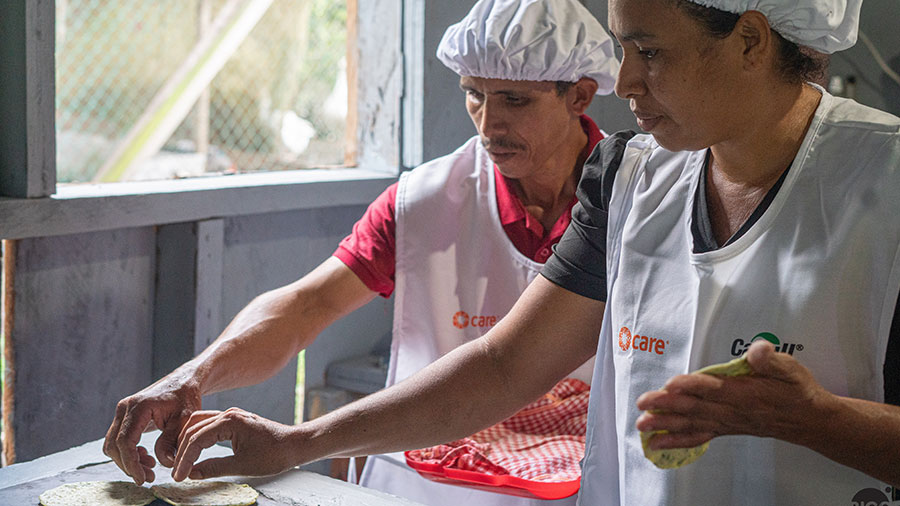
With a $15.7 million investment across 11 countries where Cargill operates, Cargill and CARE developed PROSPER III. The initiative was designed to reach nearly 1.6 million people, including more than 900,000 women. It reached more than 7 million people, nearly 4 million of whom were women.
The program was built around four connected principles:
- Market access helps turn opportunity into income. Higher yields don’t always lead to higher incomes. Farmers can increase production, but without reliable market access, income can remain unpredictable. Through PROSPER III, farmers and entrepreneurs were connected to business training, buyer networks and market opportunities. Cargill technical experts also provided training and business support across value chains, supporting stronger livelihoods while contributing to more reliable agricultural supply chains.
- Local ownership shapes long-term resilience. Village Savings and Loan Associations (VSLAs), farmer groups and local committees gave participants practical ways to save, borrow, invest in businesses, manage household needs and take part in community decision-making. Because these groups are locally led, they can continue serving communities after direct project support ends.
- Women’s participation strengthens households and communities. PROSPER III intentionally supported women’s access to financial resources, skills training and leadership opportunities. When women have greater ability to earn income, participate in decisions and contribute to local organizations, the effects often extend beyond individuals to families and communities.
- Measuring impact consistently improves decision-making. PROSPER III used common approaches to track income, food security and women’s economic participation. That helped CARE and Cargill understand what was working, align around results and focus resources where they could have the greatest impact.

What the results show
The results show how these principles translate into tangible impact for households, local economies and communities:
- More stable incomes and reduced vulnerability. Across PROSPER III communities, farming income increased by 62%, contributing to a 7% reduction in households living below the national poverty line.
- Improved food security. More than 47,000 people are no longer experiencing food insecurity, reflecting more stable and diversified access to food.
- Stronger local financial systems. Nearly 2,000 savings groups mobilized more than $7.6 million in savings and distributed close to $4.9 million in loans, fueling local enterprise and economic resilience.
- Greater participation by women. Across regions, women’s self-reported confidence in communication and negotiation skills increased by 34.7%, supporting their participation in businesses, markets, household decisions and community leadership.
What this means for resilient food systems
The pressures facing food systems are unlikely to ease anytime soon. Climate volatility, economic uncertainty and growing global demand will continue to test farming communities and supply chains around the world.
PROSPER III offers a practical lesson for the future of food systems: resilience takes more than short-term interventions. It requires partnerships designed from the start to strengthen the local systems farmers and communities already rely on — from savings groups and producer organizations to market relationships and public institutions. For CARE and Cargill, that means designing programs with the long term in mind from the start.
For Akua Laadi, the impact has been practical and deeply personal.
“Before, I waited for bread from another town. Now I bake my own and earn money every week,” she says. “I can feed my children, pay their school fees and I am even training two young women to bake. Baking has truly changed my life.”
Farmer voices
Celebrating farmers who feed our world
