
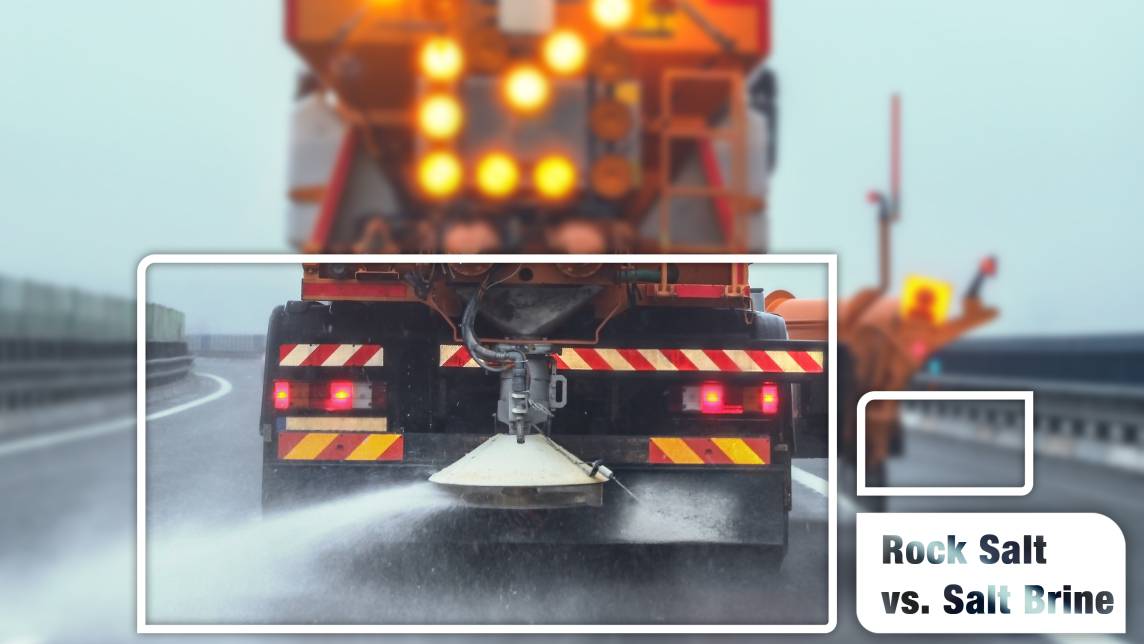
Rock Salt vs. Salt Brine
The difference between Rock Salt and Salt Brine in winter maintenance
Salt brine is a solution of salt and water that has a freezing point lower than water alone. In turn, salt brine can reduce snow and ice adhering to road surfaces. Brines can be made with sodium chloride, calcium chloride or magnesium chloride. The freezing point of brine is a function of the salt being used in the brine, such as if sodium chloride, calcium chloride, or magnesium chloride was used, and the percentage by weight of that salt in the brine.
Rock salt is simply crystals of sodium chloride, or table salt, just not as refined. Until rock salt has been formulated into brine, it will do nothing to stop snow from freezing to the roadway. Agencies that use rock salt in their winter maintenance activities are doing so to create brine on the road surface by having rock salt mix with snow, ice or freezing rain.
Rock salt is usually applied at the rate of 300 to 800 pounds per two-lane mile. As temperatures dip, either the amount of rock salt or the frequency of application must be increased. Anti-icing, which is spraying brine on roadways before the storm arrives, requires approximately one-third to one-fourth the material of deicing, making it the more cost-effective option.
Sources:
Salt Institute “The Snowfighters Handbook: A Practical Guide for Snow and Ice Control, 40th Year Edition”
Pennsylvania Department of Transportation, “Winter Operations.” Go to: https://www.penndot.gov/TravelInPA/Winter/Pages/Winter-Operations.aspx
State of Connecticut Department of Transportation, “Frequently Asked Questions.” Go to: https://www.ct.gov/dot/lib/dot/documents/dmaintenance/winter_snow_&_ice_faq_rev_11-9-15.pdf
American Public Works Association Winter Maintenance Sub-Committee, “Brine Fact Sheet,” Spring 2016. Go to: https://www.coralville.org/DocumentCenter/View/6806/Anti-Icing-Brine-Fact-Sheet?bidId=
Wisconsin Transportation Bulletin No. 6, “Using Salt and Sand for Winter Road Maintenance,” Go to: http://epdfiles.engr.wisc.edu/pdf_web_files/tic/bulletins/Bltn_006_SaltNSand.pdf