
Shea Sustainability
Supporting resilient landscapes and the producers who power the value chain
Cargill’s purpose is to nourish the world in a safe, responsible and sustainable way. As part of our global portfolio across food and personal care, shea plays an important role in helping us serve a diverse set of customers. That includes cocoa butter equivalents and shea olein in confectionery and bakery applications, as well as shea butter and other shea-derived ingredients used in personal care products and formulations. Shea fractions are part of a resilient ingredient portfolio that supports formulation flexibility and supply continuity. Shea is one part of our broader work to build more secure, transparent and responsible agricultural supply chains.
What is shea and why it matters
Shea butter is a natural fat derived from the kernels of the shea fruit, which grows across African parklands. It is widely used in food products such as cocoa butter equivalents and in personal care products such as skin and hair formulations. Shea matters because it connects producers and local communities to global markets and supports a resilient supply of ingredients used across food and personal care applications.
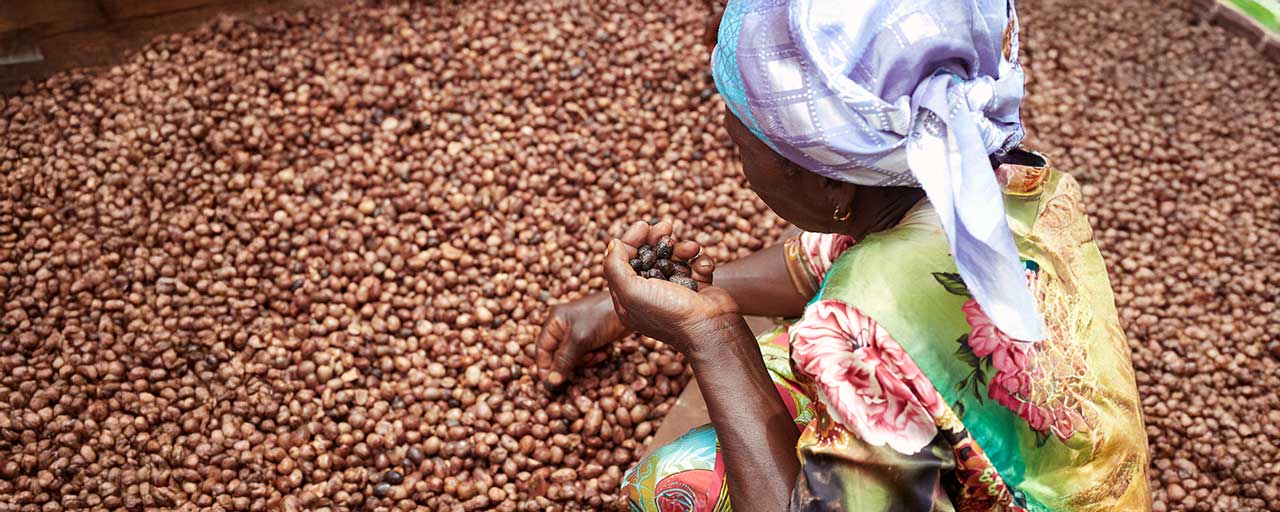
Shea trees grow across West, Central and East Africa, often interspersed with food crops. The nuts, or kernels, are primarily collected and processed by women, providing seasonal income that supports households and communities.

Defining parklands
Parklands are semi-natural, savanna-like landscapes where scattered native trees grow among crops and grasses. In West Africa, parklands commonly support naturally occurring shea trees and are managed as mixed-use landscapes that combine ecological value with local livelihoods.
Industry context and challenges
The shea sector supports rural livelihoods and global ingredient markets. It also faces several structural challenges, including aging and declining tree stocks in some regions, limited protection and management of parklands, and income volatility and barriers to finance for producers. Post-harvest processing can also be labor-intensive and difficult, especially where access to improved tools, infrastructure and market connections is limited. At the same time, demand for shea-derived ingredients continues to grow across food and personal care applications.

Why sustainability matters in the shea supply chain
Strengthening sustainability efforts in the shea supply chain can help address tree-stock decline, improve the efficiency and safety of post-harvest processing, and create economic opportunities for collectors, many of whom are women. It can also help support a more resilient supply of shea products for customers, including cocoa butter equivalents, while protecting the long-lived tree assets and biodiversity values of parklands.


Our approach to responsible shea
Cargill’s approach to shea builds on our broader policies and practices across responsible sourcing, forests and climate that prioritize producer livelihoods, uphold human rights, and improve transparency. By strengthening shea supply chains, we aim to support both the long-term resilience of parkland ecosystems and producer communities and reliable access to high-quality ingredients for customers.
Industry
Cargill participates in industry dialogue and technical exchanges to advance responsible shea practices across parklands and value chains. We are active in forums that address parkland stewardship, post-harvest improvements and traceability, and we collaborate with peers and local stakeholders to align incentives for more resilient supply chains.
What this looks like in practice:
- Participating in Global Shea Alliance working groups and sector dialogues
- Sharing good practices on post-harvest processing, safe working practices and parkland stewardship
- Supporting work that builds the evidence base for how supply chain interventions can strengthen livelihoods and landscape regeneration

Partnership
Partnerships are essential for scalable improvements. Cargill co-funded a Global Shea Alliance project in Northern Ghana between 2021 and 2025 alongside The Body Shop International, Solidaridad West Africa, Tungteiya and The Lorna Young Foundation, with the objective of increasing incomes and improving livelihoods among shea-producing communities. We continue to evaluate collaborative opportunities that combine technical assistance, landscape stewardship and market access.
We prioritize partnerships that are locally led, respect producer agency, and balance environmental stewardship with income opportunities for producers.
What this looks like in practice:
- Co-designing interventions with local organizations and producers’ groups
- Investing in capacity building and durable infrastructure for safer, higher-quality post-harvest processing
- Aligning partner efforts to reduce duplication and support local value-chain development

Sourcing
Cargill is working to increase direct sourcing from women’s producer groups in West Africa where feasible, while continuing to source responsibly through intermediated routes. We are piloting a local sourcing model for shea kernels with local companies in West Africa and have a longer-term vision to purchase directly from women’s groups over time.
As part of this strategy, we are exploring how well-designed direct relationships can improve traceability, support fairer pricing or pre-financing mechanisms, and strengthen producer agency.
What this looks like in practice:
- Piloting direct shea kernel sourcing with local processing partners while developing a longer-term strategy for direct purchasing from women’s groups
- Using risk-based due diligence to guide sourcing routes and supplier engagement


How the shea supply chain works
From tree to ingredient
- Collection: Producers gather ripe shea fruit or kernels from parklands
- Post-harvest handling: Kernels are sorted, dried and prepared for sale
- Aggregation and trading: Local networks consolidate supply and move kernels to processors
- Processing: Kernels are dried, crushed and processed into shea butter
- Fractionation and refining: Shea butter is further processed into ingredients used in products like cocoa butter equivalents
- End use: Used in food products and personal care formulations
Why shea is important for resilient supply chains
- Supports women’s livelihoods by providing seasonal income across rural sourcing regions
- Protects parkland ecosystems that support biodiversity, carbon capture and food production
- Enables resilient ingredient supply for food and personal care manufacturers
- Connects local communities to global markets through agricultural value chains
Sustainable Shea FAQs
Explore common questions about how Cargill approaches sustainability across its shea supply chain.
What is sustainable shea?
Sustainable shea refers to sourcing practices that protect parkland ecosystems and support rural communities and farmer livelihoods, especially women.
Where does shea butter come from?
Shea butter comes from the nuts of the shea fruit, which grows naturally across several African countries, especially in West Africa.
How is shea sourced?
Shea is typically collected by women, processed locally, and sold through a network of intermediaries or, in some cases, through more direct sourcing models.
Why is shea important in food products?
Shea products are used in applications such as cocoa butter equivalents, helping manufacturers maintain product quality and supply flexibility.

All photos attributed to Global Shea Alliance unless otherwise noted.