
PriNext™
Next-gen isocyanate developmental alternative for 2K systems
Bye-bye isocyanate, hello innovation!
As the industry rapidly advances to meet the demand for intelligent, multifunctional products, it also faces sustainability challenges, driven by stricter regulations and a demand for tangible solutions. Cargill's PriNext™ developmental technology is here to innovate the market by offering a high-performance product range alternative to the use of isocyanates in 2K polyurethanes formulations, addressing both regulatory and practical concerns.
Why PriNext?
Innovative technology: PriNext is an acetoacetate polymer based on Cargill dimer technology.
Polyurethane alternative: achieve benefits comparable to polyurethane with a new technology.
No EU REACH training needed*: alleviate the restrictive requirements associated with isocyanate use.
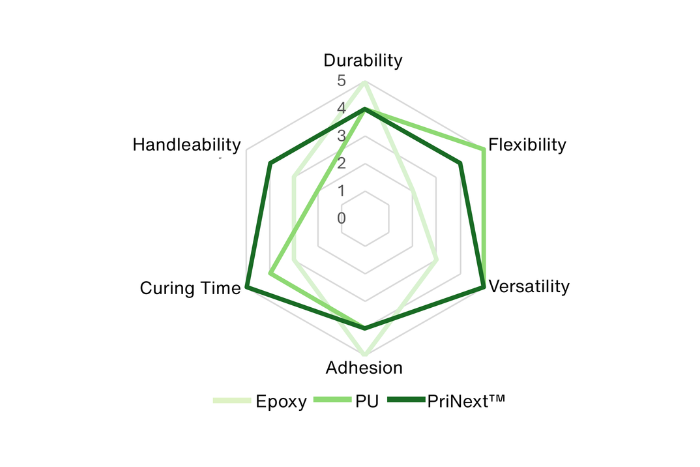
Systems benefits comparison:
Product highlights
Versatile product range
Compatible with various acrylates and CASE applications
Energy and time saving
Fast curing at room temperature without the need for specific storage conditions
No moisture sensitivity
Does not react with water, helping to avoid foaming issues
Versatile product range
Meet market needs
| PriNext product | Dev code | Functional AcAc- group | Mw | Active hydrogens | Dynamic viscosity @25 ºC (mPa.s) | Tg (ºC) |
|---|---|---|---|---|---|---|
| PriNext 2F1 | DEV2226 | 2 | 1250 | 4 | 8900 | -39 |
| PriNext 4F1 | DEV2331 | 4 | 1425 | 8 | 7400 | -56 |
| PriNext 6F1 | DEV2327 | 6 | 1550 | 12 | 38000 | -42 |
| PriNext 6F2 | DEV2330 | 6 | 1200 | 12 | 16500 | -40 |
PriNext™ is a developmental technology currently available for sampling purposes. It is not yet commercially available.
Ready for the Next?
Embrace the next generation of 2K systems isocyanate alternative.
PriNext Technology Calculator
We want to help you simplify your formulation tests.
Frequently asked questions
Can PriNext be used in water-based systems (like 2K PUD)?
This is possible via resin emulsification using an external emulsifier. The concept will be tested in due course, but currently no data is available.
Can PriNext be cut with reactive thinners to reduce its viscosity?
Mono- and Di-functional acrylates can be used to reduce the complete formulation. PriNext itself can potentially be cut in low molecular weight AcAc-products. However, lower Mw components will have an effect on the application properties.
How is the weathering performance?
90% retention of adhesion strength after 120-240 hours of exposure at 85°C and 85% relative humidity. 500 and 1000h tests are ongoing.
How is the adhesion of ceramic (tiles) on wood, and metal on wood in marine applications (e.g., leisure boats)?
Our test data show excellent adhesion to dissimilar substrates.
The Michael addition is reversible with another catalyst. Can that be used for debonding on demand?
Yes, when used in vitrimers. But PriNext is not an ideal building block for making vitrimers.
Would AcAc cure without a catalyst at elevated temperatures?
No, there is always a basic catalyst needed.
Are the products commercial?
PriNext™ is a developmental technology currently available for sampling purposes. It is not yet commercially available.
Is it possible to work with PriNext in humid conditions?
Yes, PriNext can be used in humid environments; however, its performance may depend on the duration of exposure and the temperature of those conditions. While the formulations are generally not highly sensitive to moisture, since they lack groups that readily react with water, prolonged exposure to high humidity and elevated temperatures could lead to hydrolysis over time. For critical applications, hydrolysis testing under expected environmental conditions is recommended.
Yellowing resistance?
Tests are ongoing at this point. Results will be communicated as they become available.
Is it possible to formulate a very fast curing system (15 sec) using PriNext, e.g., for textile printing?
By using higher amounts of catalyst and some heat, it might be possible.
*According to REACH Annex XVII, entry 74, that mandates training for workers handling diisocyanates to reduce the risk of respiratory and dermal sensitization.